
We Brought Receipts
For the last nine months I've sacrificed writing for building. Now I can share the best measurable path to purchase for BevAlc, with the receipts to back it.

I love writing. It’s my way of thinking out loud and sharing what I’ve learned. But for the past nine months, I have barely put word to paper. Now I’m finding my way again.
The reason is simple: writing takes time, and every hour I had went into building something that I believe will change the industry for the better and help overcome the headwinds we’re all facing.
I’ve been pushing technology in this industry for two decades. I’ve built companies that succeeded and one that didn’t. Pix didn’t make it, and I’ve been open and transparent about why. The wine and spirits industry has faced many challenges but still lacks platforms that have genuinely improved it. There were quite a few that were promising, but either their execution was wanting, or market pressures forced them to bend their vision into a dead end. There are a few standouts, like Commerce7, who have made genuine, positive differences in the market for brands that use their websites to market and sell wine DTC. But most wine and spirits are not sold DTC, leaving a giant gap. That gap is what keeps pulling me back to the category. That gap is a better, measurable path to purchase.
Across every venture, every success, failure, and hard lesson, I keep coming back to the category, trying to build solutions that make a difference using digital tools.
The reason it’s so hard for alcohol beverage brands to succeed online is that there has never been a comprehensive, compliant, successful path to purchase.
Think about what exists today. One model degrades the product’s value, competing only on price until everyone races to the bottom. Another inserts itself as a middleman, taking a cut of every sale. Another restricts where shoppers can buy, funneling them through a narrow set of retailers. And almost all of them ignore the one person who matters most: the shopper who wants to buy what they want, when they want, from whoever they want, in the way they want.
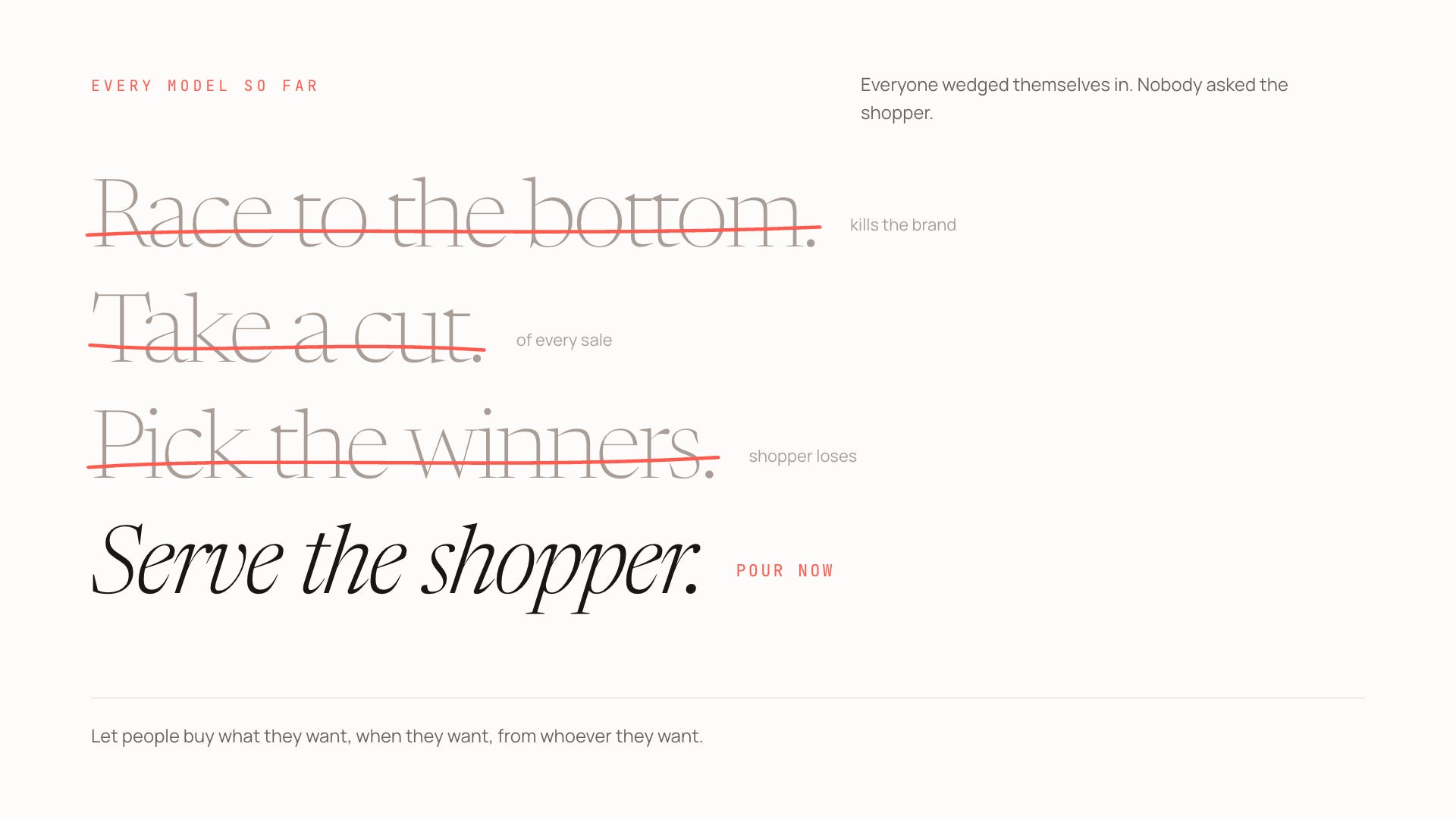
Nobody has solved that problem. Instead, companies tried to wedge themselves into the shopper journey, adding another layer to the three-tier system, and almost none of them delivered meaningful success for brands. Very few of them delivered anything for shoppers. My last venture had glimmers of hope, but being solely wine-focused made it too narrow to succeed. The core issue remains: the shopper still lacks a clear path to purchase.
That’s a genuinely hard problem. It takes energy, effort, and, more than anything, objectivity and the willingness to build what’s actually good for the shopper rather than just trying to extract value from the brand or the retailer.
And so for years, “Where to buy” has been a dead end. A desert of maps, complicated networks of grey shipping methods, or marketplaces that consume our industry.

Sixteen to eighteen-hour days working hard since we did a soft reveal at the end of January. That’s what we’ve been building. And not just me, three other founders putting in just as much time and energy: Andrew Levy (CEO), David Round MW (Head of Taxonomy), and Julianna Bologa (Chief of Staff). That’s why I’ve been so absent from writing. We’ve been consumed with building.
The model we’ve built is simple to describe and hard to execute. We’ve created a measurable path to purchase in a consumer application that doesn’t favor retailers or focus only on the lowest price. Brands, publications, partners, and associations can leverage our platform to help shoppers find and measurably buy BevAlc products. We built it to protect brand value, give retailers objective and equal opportunities, and, above all, serve the shopper first with the best choices and the most context for a buying decision that matches their needs. We are adamant about never taking a percentage of the sale. We’re the most compliant solution in the category. Brands pay us to guide their shoppers to find and buy successfully and measurably, and we never do it by driving them through marketplaces that erode retailer margins and strip lifetime value.
We believe brands should support their retail network, not undercut it. We don’t exclude direct-to-consumer – brands can add it if they want, because we genuinely believe in omnichannel. Let the shopper buy how they want, from who they want, when they want. And we never exclude a retailer. If a retailer has an available online path to purchase (pickup, shipping, or delivery), you’re welcome to join free of charge.
After my last venture, I didn’t want to hype this startup. I spoke extensively with the team about how we wanted to bring it to life, build it, and pressure-test it so that when we did start talking about it in public, everyone could see the value we created and the results would be so well proven that we would not be a question, but a working solution.
Instead of telling you about a vision and asking you to imagine how it works, I can simply show you (click the image below):

We had a soft-launch in January, but we’ve barely announced what we’re doing. But this month we’ve decided that it’s time to really share what we’ve done and how we help brands of ALL sizes. The stats show the team’s hard work. We already have nearly 500 brands on the platform and have integrated with almost 30,000 retailers. We have nearly 150 million products in the database. By the end of this year, we’ll have 85% of retailers who sell online available in the system. And we outperform every other platform by 5x. It’s not a promise; it’s a fact, now backed by numerous case studies: competitive head-to-head, marketing ROAS, move lazy inventory, and many more that we’re happy to share.
I’ve written a lot over the years about models that work and models that don’t. But there have been very few that were perfectly designed for the wine and spirits industry. But with so many tech companies selling the vision versus the reality, we wanted to anchor our marketing and communications on real-world examples, not screenshots of what is possible. Now, with almost 500 brands live in just over a year, and only six months from starting to come out of stealth, we have lots of examples, and we have the best job in the industry: helping shoppers find and measurably buy wine and spirits.
We can help nearly any brand in distribution deliver shoppers to DMAs with retailers that carry your products, and increase your sales velocity in the market. We can turn your marketing from a guess to measurable sales results. And we have pricing built to help the industry get the most value at every tier.
If a better, measurable shopper experience isn’t enough to sell you, here is a sampling of actual receipts from brands already using Pour Now as their marketing path to purchase.
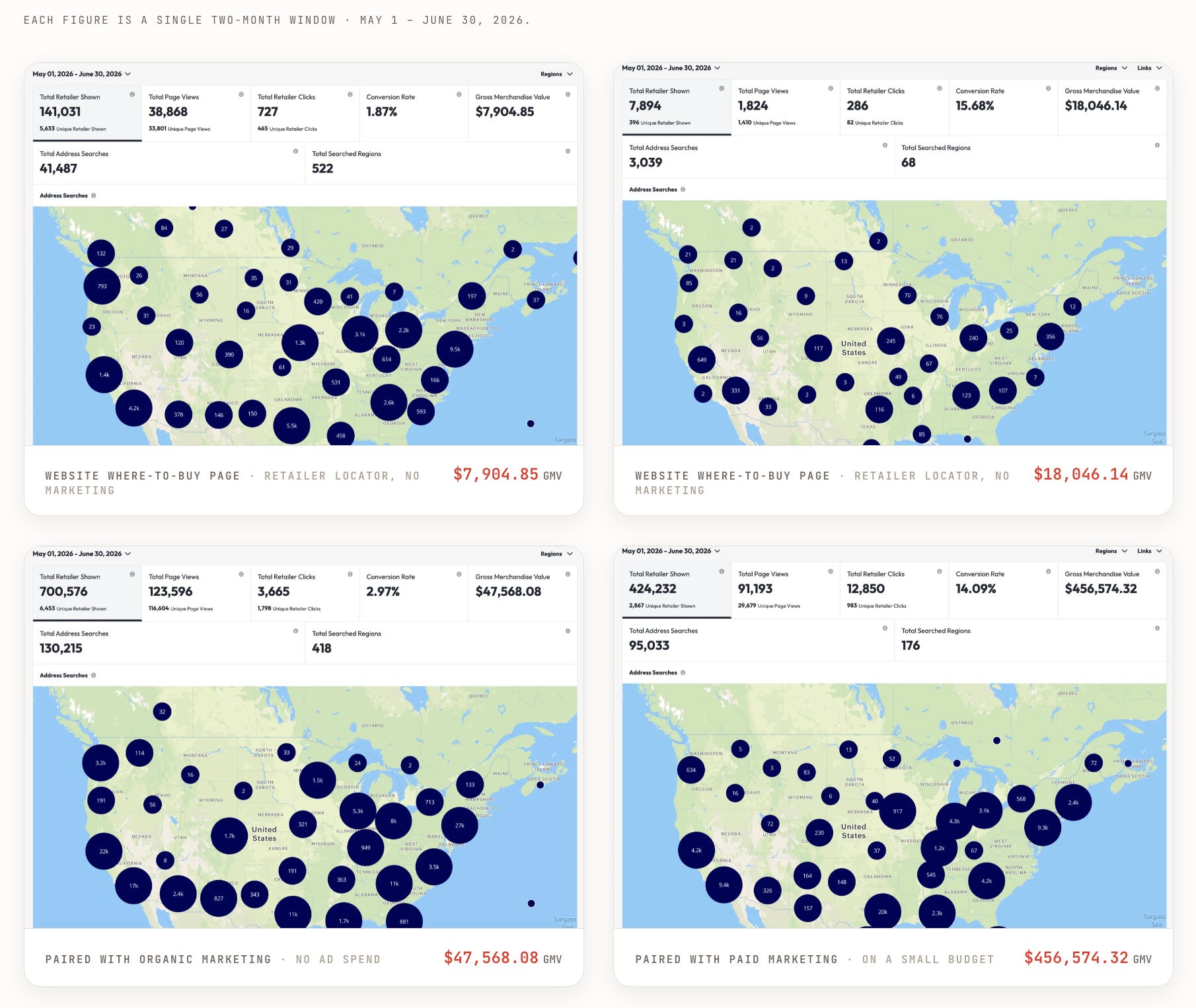
That’s what has been consuming the first part of my year, but now my weekends are freeing up a bit, and with the newfound time, I am able to look at the screen with a new set of inspiration and write again. I have some fun pieces in the queue.
It’s good to be back.
Hi Paul, couple of tiny points. In your screenshot ishanti is listed as nearby but 1300 miles away. I’d update that screenshot. And when looking for proof it’s not clear what or who Juliana is and why they want my email. And fwiw as a consumer it’s still unclear what the experience is. This isn’t so much criticism as I hope it’s helpful feedback that’s relatively easy to fix and will hopefully smooth out a few points of friction for conversion. Congratulations on your launch.
Great work Paul. Looking forward to catching up and talking about this more soon.